Strategy analysis
Jupiter Global is Big, Here's Why
A strategy analysis on why Jupiter's APAC-first move actually makes sense.
TL;DR
Jupiter Global isn't just a crypto payments app. It's a bet on a market that was already there.
- 709 million active UPI QR codes in India. More payment touchpoints than adults with bank accounts in most of the Western world.
- APAC accounts for 60% of global QR payment activity. QR isn't new there. It's just how people pay.
- Crypto adoption in APAC is about usage, not speculation. People aren't watching charts. They're sending remittances, paying merchants, and solving real daily problems.
- Jupiter went APAC-first because getting people to adopt is almost free. The behavior already exists. They just swapped what runs underneath.
- Here's why it matters: Once Jupiter owns APAC volume and transaction data, they can go after the US from a position of strength. Not as a startup asking for a chance. As a platform already processing billions.
What Jupiter Actually Is (And Isn't)
Most people read Jupiter as "DeFi superapp on Solana." That's the surface.
Most crypto card companies launch in the US or Europe first. Payments gets added as a feature. Jupiter did it differently. They built payments as the core product and pointed it straight at Asia-Pacific, where the behavior already exists.
From the outside, Jupiter's pace looks reckless. In roughly a year, they shipped a DEX aggregator upgrade, perpetuals, limit orders, DCA, a mobile wallet, a stablecoin (JupUSD), lending, a prediction market integration, Jupiter Global with QR payments and fiat accounts, and a USDC card. They cooked extremely hard. That's a lot of surface area.
But look closer and there's a clear pattern. Some of these are experiments: testing what sticks, expanding options. Others are obvious game-winning products built to lock in position. Jupiter Global is the second one. The geographic sequencing alone tells you this wasn't a feature launch. It was a deliberate placement.
Why APAC First is The Winning Ticket Into Payments
1. QR Payments Aren't An Experiment in APAC. They're The Default.
Asia-Pacific accounts for over 60% of global QR code payment activity. The numbers are staggering:
- India's UPI QR network: 709M+ active QR codes by late 2025, billions of contactless transactions
- Vietnam: QR payments grew 61.6% in volume and 150.7% in value year-on-year
- Thailand: PromptPay drives 44% of online spend and 43% of in-person spend
- Malaysia: Ranks 2nd globally in QR adoption at 61.5%, behind only China (67.4%). DuitNow QR transactions doubled to 3 billion in 2025, with nearly 3 million registered QR touchpoints. 80% of those are small businesses that previously ran on cash only
- Southeast Asia QR transactions projected to grow from 13B (2023) to 90B+ by 2028
- APAC QR payment value expected to grow 300% by 2029, from $290B in 2025
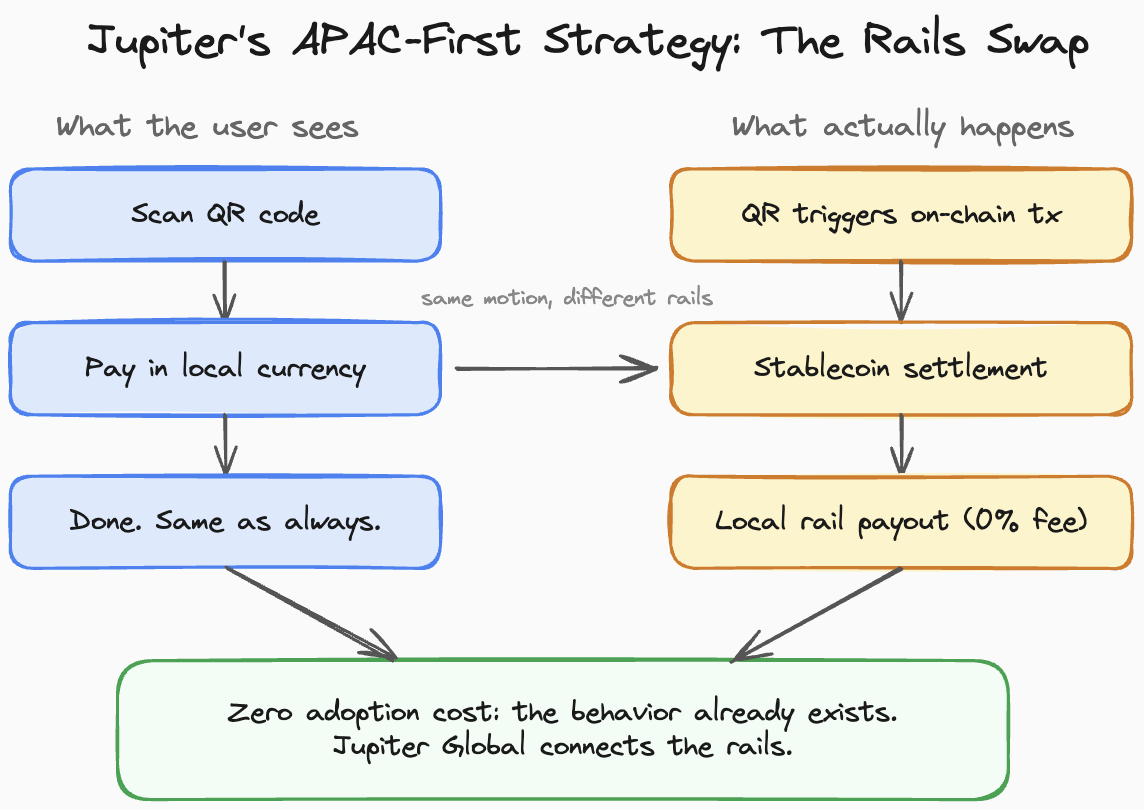
When Jupiter ships QR payments in these markets, they're not trying to change behavior. They're slotting into it.
Here's the thing: when QR payments are already part of how people live, getting them to use your product costs almost nothing. No education needed. No convincing. People are already doing this every day.
In Vietnam, street vendors accept QR. In Thailand, PromptPay handles 44% of in-person spend. That's not an app people open on purpose. It's just how you pay for lunch. In Malaysia, 61.5% of people use QR payments. DuitNow QR transactions doubled to 3 billion in 2025, and 80% of those touchpoints are small businesses that were cash-only just a few years ago. In India, 709 million active UPI QR codes means there are more payment touchpoints than adults with bank accounts in most Western countries.
At that scale, QR payments aren't a "payment method" anymore. They're just part of how things work.
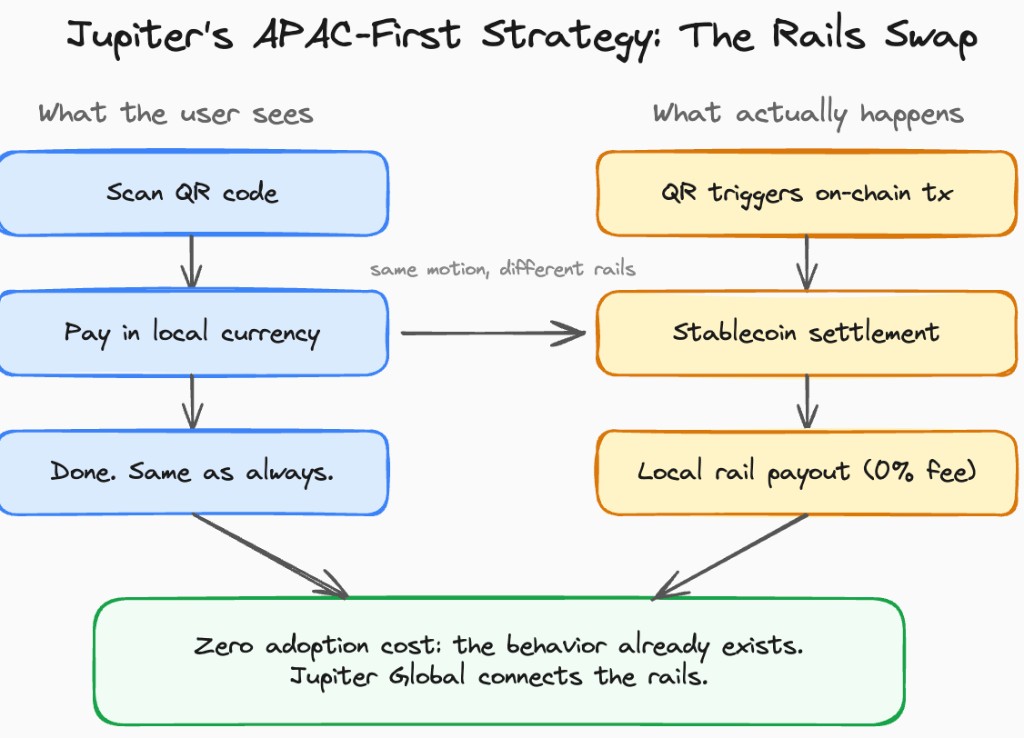
So here's what makes Jupiter different from a crypto payments startup going US-first. In the US, you'd be asking people to change how they pay. You'd need to convince merchants, teach users, and fight credit card networks for every inch. In APAC, scan-to-pay is already muscle memory. The only thing that changes is what's happening underneath: stablecoin settlement instead of bank-to-bank. The user doesn't know. The user doesn't care. The blockchain just becomes the pipes behind the wall.
This is why APAC-first isn't just a market choice. It's a different way of thinking about adoption. You go where the behavior already exists. Then you change what runs beneath it.
2. Crypto Adoption in APAC Is About Using It, Not Owning It
This is the part most Western crypto builders miss.
In the Chainalysis 2025 Global Adoption Index, the top APAC countries are India (1st), Vietnam (4th), Indonesia (7th), and the Philippines (9th). These aren't countries full of people watching charts. They're countries where:
- Remittances are a big share of GDP
- Stablecoin corridors are cutting remittance costs below 1%
- 1.3M+ merchants in the Philippines alone are already using crypto payment processors
- Total APAC crypto transaction volume grew from $1.4T to $2.36T
@weremeow said it directly: "Decentralized adoption is not when people buy crypto, it is when people use crypto."
Ownership is speculation. Usage is infrastructure. APAC is where usage lives.
3. The Infrastructure Already Exists. Jupiter Just Plugs In.
Stablecoin payments in Southeast Asia are going quiet. Users scan a QR code, pay in local currency, and the settlement happens through stablecoin rails underneath. The user has no idea. This is exactly what Jupiter Global is built for: routing through local payment systems, supporting multi-currency virtual accounts, and processing via QR.
The US is a different story:
- Card payments dominate and QR adoption is low
- Regulatory overhead is massive and unpredictable
- Crypto adoption is mostly about speculation and trading
- The compliance burden for a payments product is about 10x what it is in most APAC countries
Going US-first would mean fighting for users in a market where the core behavior, QR payments, doesn't even exist at scale. Going APAC-first means landing in a market that's already built for you.
4. Why Other Payment Companies Can't Just Follow
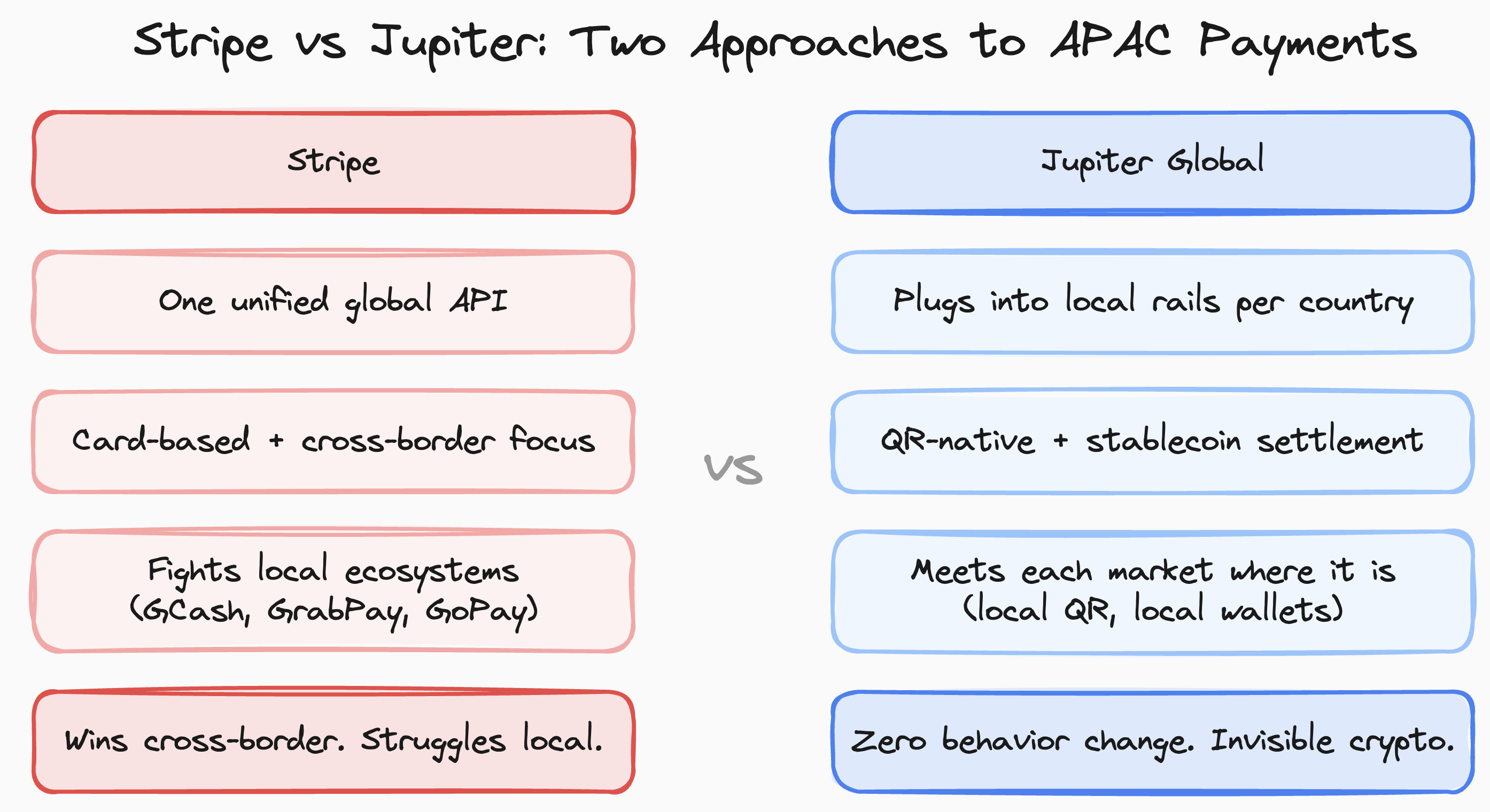
Stripe is probably the best payments infrastructure company out there. And they still struggle with APAC's consumer layer.
They're live in Singapore, Thailand, Malaysia, and expanding into Indonesia. But their strength is cross-border e-commerce and card-based payments. The local consumer payments market is a completely different game. Every country runs on its own rails:
- GCash dominates the Philippines with 94 million registered users (81 million active)
- GrabPay leads Singapore (~35%) and Malaysia (~38%)
- GoPay leads Indonesia with 500M+ monthly transactions
- PromptPay owns Thailand
These aren't just apps. They're built into local ecosystems, telecom networks, ride-hailing platforms, government systems. A foreign company can't replicate that by opening an office.
The Strategic Sequencing
This is a classic go-where-the-pull-is move. Build density in markets where:
- The payment behavior already matches your product (QR-native)
- The user need is real and daily (remittances, cross-border payments)
- The regulatory friction is lower
- The existing players haven't locked things down yet
Then, once you have volume, transaction data, and a working product, you go after regulated Western markets from a position of strength. Not as a startup trying to get its first users. As a platform already processing billions in real transactions.
Jupiter isn't just a DEX that added payments. It's making a bet that the path to becoming crypto's global financial layer runs through Manila, Bangkok, and Ho Chi Minh City. Not San Francisco.
Separating Experiments From Bets
The rapid product launches make more sense once you split them into two buckets.
Perpetuals, DCA, limit orders, prediction market integration: these are experiments. They expand the surface area, test demand, and keep existing users around. Jupiter Global is different.
I spoke with @kashdhanda briefly in Catlumpur. The seriousness is visible up close. They're not just thinking about products. Jupiter is building a financial system. They treat compliance like it's plumbing: not glamorous, but absolutely necessary for everything else to work. That's not how most crypto teams think. And that's why Jupiter will win this race.
If you're not building for consumers, you're not building the future of finance. Jupiter is building for consumers. And they're not waiting for anyone's permission.